> ## Documentation Index
> Fetch the complete documentation index at: https://docs.primev.xyz/llms.txt
> Use this file to discover all available pages before exploring further.
# Rewards and Slashing
The providers and validators that opt-in to the mev-commit protocol are incentivized to act honestly and follow the protocol. This honest behavior is enforced by a reward and slashing mechanism. Both the providers and the validators are required to stake or restake a certain amount of tokens to participate in the mev-commit protocol. The mechanism is designed to reward providers for fulfilling their commitments and to penalize them for breaking them. It also disincentivizes providers from issuing commitments that they cannot fulfill.
Validators have three methods to opt-in to mev-commit, as described in the [validators section](/v1.2.x/get-started/validators). Staking (or restaking) signals validator participation in the mev-commit commitment market and aligns incentives with honest behavior. The primary slashing surface in mev-commit is on the provider (block builder) side — providers are penalized for breaking commitments they issued. Validators are not penalized for the builder their relay happens to select. Next, we discuss the rewards and slashing mechanisms for validators and providers in more detail.
The risk of getting slashed is very low for validators, unless they intentionally behave dishonestly. This has been confirmed by an [independent report on the risk/reward profile of mev-commit by Chaos Labs](https://governance.ether.fi/t/primev-symbiotic-risk-analysis/).
## Validators/Proposers
A validator that opts into mev-commit signals participation in the mev-commit commitment market. Opted-in validators receive higher-value blocks whenever mev-commit bids are present in their slot. There is no requirement to restrict block selection to registered providers — validators may continue using their existing relay set unchanged.
### Rewards
There are two categories of rewards for validators opting in to mev-commit:
1. Increased yield
2. [Points](/v1.2.x/concepts/rewards-and-slashing/points)
The main reward for proposers opting in to mev-commit is increased yield by proposing a more valuable block, paid through the mev-boost auction. Upon proposing a block while opted-in to mev-commit, a proposer will receive all bid related value in the mev-commit network that is surfaced by the mev-boost auction embedded in the block they propose. In other words, proposers passively receive rewards from mev-commit by proposing more valuable blocks that include increased value from mev-commit bids. A proposer will almost always propose a more valuable block using mev-commit than without while mev-commit bids are present for its slot.
Using an example of a block worth 1 ETH and mev-commit bids worth 0.1 ETH, the diagram below depicts Validator Rewards with and without mev-commit:
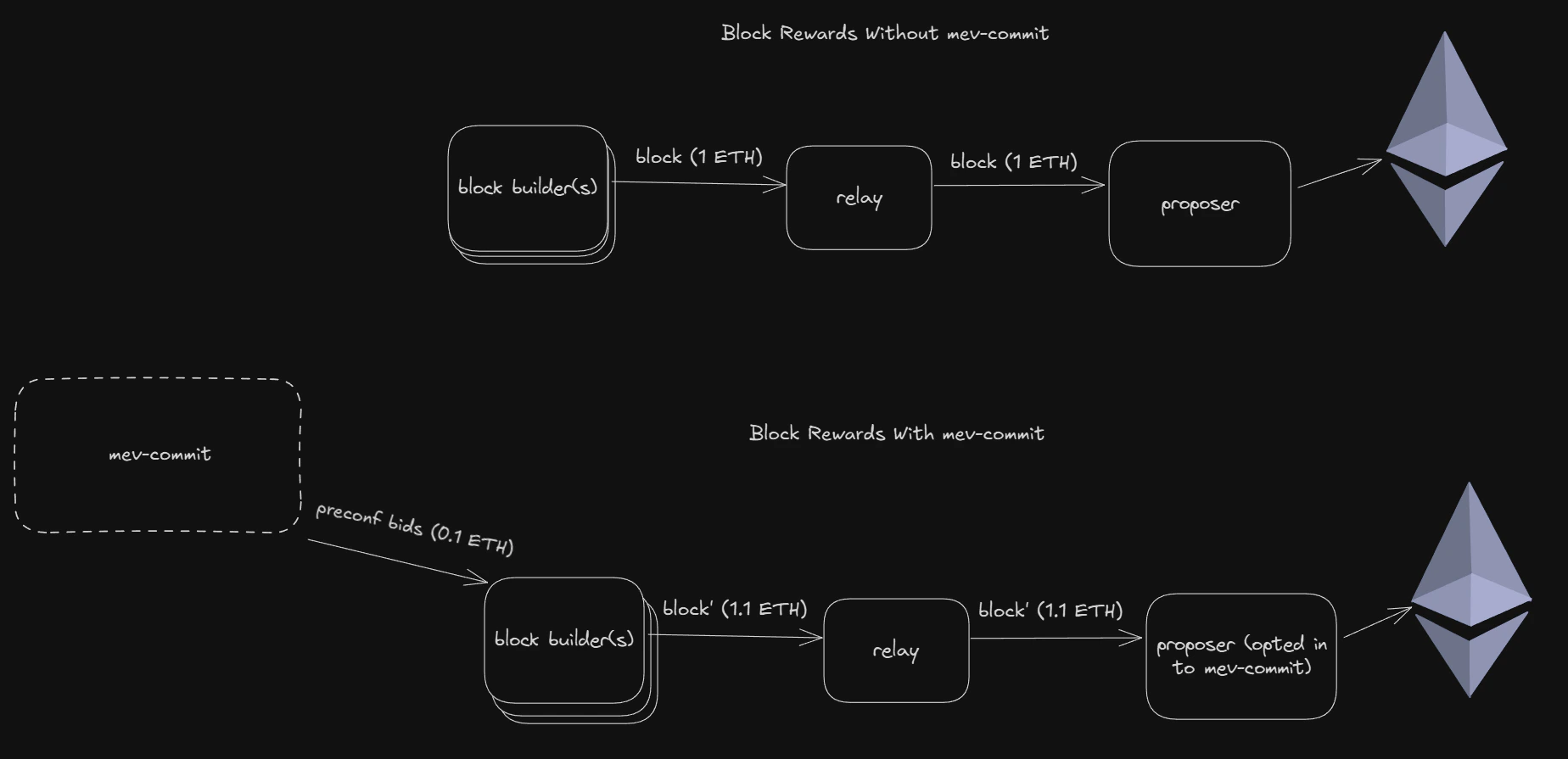 An important observation here is that proposers opting in increases the credibility of the preconfs and consequently their value. Due to the increased preconf values, the providers have additional value to bid in the mev-boost auction, thus driving up the total revenue a proposer will get.
### Slashing
Validators are **not expected to be slashed** on mev-commit. Providers (block builders) are the primary decision makers liable for slashing — they are accountable for honoring the commitments they issued. Validators are not penalized for missed blocks, self-built blocks, or for the builder their relay happened to select.
#### Missed Block
A proposer can completely miss its slot and not include any block in L1. This can happen due to network issues, relay delivery problems, or chain reorgs. mev-commit does not slash proposers for missed blocks — the proposer does not profit from omitting a block and the cause is often outside their control.
#### Block from Non-Registered Builder
A proposer may include a block in L1 that was not produced by a registered mev-commit provider — for example because the highest-value bid that slot came from a non-registered builder. mev-commit does not slash validators for this. Commitment accountability is enforced at the provider layer: if a registered provider issued a commitment for a transaction, breaking that commitment slashes the provider regardless of who ultimately won the slot.
#### Self-Built Block
A proposer can include a block that was built locally rather than through mev-boost. This typically happens when relay-supplied bids are below the locally-built value or when mev-boost falls back due to a fault. mev-commit does not slash proposers for self-built blocks.
## Providers
There are four possible outcomes after a commitment is made by a provider and an Ethereum block is proposed:
1. The bid amount is rewarded to the provider for fulfilling the commitment.
2. The provider stake is slashed for breaking the commitment.
3. Nothing happens as neither the provider nor the bidder opened the commitment.
We discuss each case in more detail below.
### Rewards
Upon successfully fulfilling a commitment, a provider will be rewarded the bid amount, minus a 2% fee (this fee accumulates in the mev-commit protocol treasury). This reward is paid by the mev-commit oracle to the provider’s account after the corresponding slot is settled by the oracle according to the block included in L1.
### Slashing for Broken Commitment
Upon breaking a commitment, a provider's stake will be slashed exactly equal to the slash amount specified in the bid they committed to, in addition to a 5% penalty fee. Decay is **not** applied to the slash amount. The principal slash amount will be transferred to the bidder for the broken commitment, and the penalty fee will be transferred to the mev-commit protocol treasury.
If the provider does not have enough stake left to cover the entirety of the slash amount and penalty fee, the maximal amount of the slash amount that can be slashed will be slashed and given to the bidder. Any remaining funds in the provider's stake will go towards maximally paying the 5% slashing penalty to the treasury.
The precedence means the slash amount that goes to the bidder will be prioritized first, and only after that will the treasury be compensated for as much of the 5% slashing penalty as possible.
### Neutral Outcome
The protocol does not take action on commitments that are not opened by the provider or the bidder. This happens if the commitment provider is not the execution provider for the corresponding winning block, in which case there is no point in opening the commitment.
## Builder and Proposer Attribution
We rely on the BLS key used to submit to the relay to do attribution and determine the block builder for a particular block.
An important observation here is that proposers opting in increases the credibility of the preconfs and consequently their value. Due to the increased preconf values, the providers have additional value to bid in the mev-boost auction, thus driving up the total revenue a proposer will get.
### Slashing
Validators are **not expected to be slashed** on mev-commit. Providers (block builders) are the primary decision makers liable for slashing — they are accountable for honoring the commitments they issued. Validators are not penalized for missed blocks, self-built blocks, or for the builder their relay happened to select.
#### Missed Block
A proposer can completely miss its slot and not include any block in L1. This can happen due to network issues, relay delivery problems, or chain reorgs. mev-commit does not slash proposers for missed blocks — the proposer does not profit from omitting a block and the cause is often outside their control.
#### Block from Non-Registered Builder
A proposer may include a block in L1 that was not produced by a registered mev-commit provider — for example because the highest-value bid that slot came from a non-registered builder. mev-commit does not slash validators for this. Commitment accountability is enforced at the provider layer: if a registered provider issued a commitment for a transaction, breaking that commitment slashes the provider regardless of who ultimately won the slot.
#### Self-Built Block
A proposer can include a block that was built locally rather than through mev-boost. This typically happens when relay-supplied bids are below the locally-built value or when mev-boost falls back due to a fault. mev-commit does not slash proposers for self-built blocks.
## Providers
There are four possible outcomes after a commitment is made by a provider and an Ethereum block is proposed:
1. The bid amount is rewarded to the provider for fulfilling the commitment.
2. The provider stake is slashed for breaking the commitment.
3. Nothing happens as neither the provider nor the bidder opened the commitment.
We discuss each case in more detail below.
### Rewards
Upon successfully fulfilling a commitment, a provider will be rewarded the bid amount, minus a 2% fee (this fee accumulates in the mev-commit protocol treasury). This reward is paid by the mev-commit oracle to the provider’s account after the corresponding slot is settled by the oracle according to the block included in L1.
### Slashing for Broken Commitment
Upon breaking a commitment, a provider's stake will be slashed exactly equal to the slash amount specified in the bid they committed to, in addition to a 5% penalty fee. Decay is **not** applied to the slash amount. The principal slash amount will be transferred to the bidder for the broken commitment, and the penalty fee will be transferred to the mev-commit protocol treasury.
If the provider does not have enough stake left to cover the entirety of the slash amount and penalty fee, the maximal amount of the slash amount that can be slashed will be slashed and given to the bidder. Any remaining funds in the provider's stake will go towards maximally paying the 5% slashing penalty to the treasury.
The precedence means the slash amount that goes to the bidder will be prioritized first, and only after that will the treasury be compensated for as much of the 5% slashing penalty as possible.
### Neutral Outcome
The protocol does not take action on commitments that are not opened by the provider or the bidder. This happens if the commitment provider is not the execution provider for the corresponding winning block, in which case there is no point in opening the commitment.
## Builder and Proposer Attribution
We rely on the BLS key used to submit to the relay to do attribution and determine the block builder for a particular block.