> ## Documentation Index
> Fetch the complete documentation index at: https://docs.primev.xyz/llms.txt
> Use this file to discover all available pages before exploring further.
# Relay Integration Guide
export const HoodiValidatorOptInRouterAddress = "0xa380ba6d6083a4Cb2a3B62b0a81Ea8727861c13e";
export const ProviderRegistryAddress_1_1_6 = "0x1C2a592950E5dAd49c0E2F3A402DCF496bdf7b67";
export const ValidatorOptInRouterProxyAddress = "0x821798d7b9d57dF7Ed7616ef9111A616aB19ed64";
export const ProviderRegistryAddressMainnet1_0_0 = "0xeb6d22309062a86fa194520344530874221ef48c";
## Overview
Enabling mev-commit on your relay is simple and requires minimal changes to your existing setup.
This guide explains how to integrate your relay with mev-commit.
Your relay will check if the current slot's validator has opted into mev-commit:
* If they haven't opted in, your relay works normally:
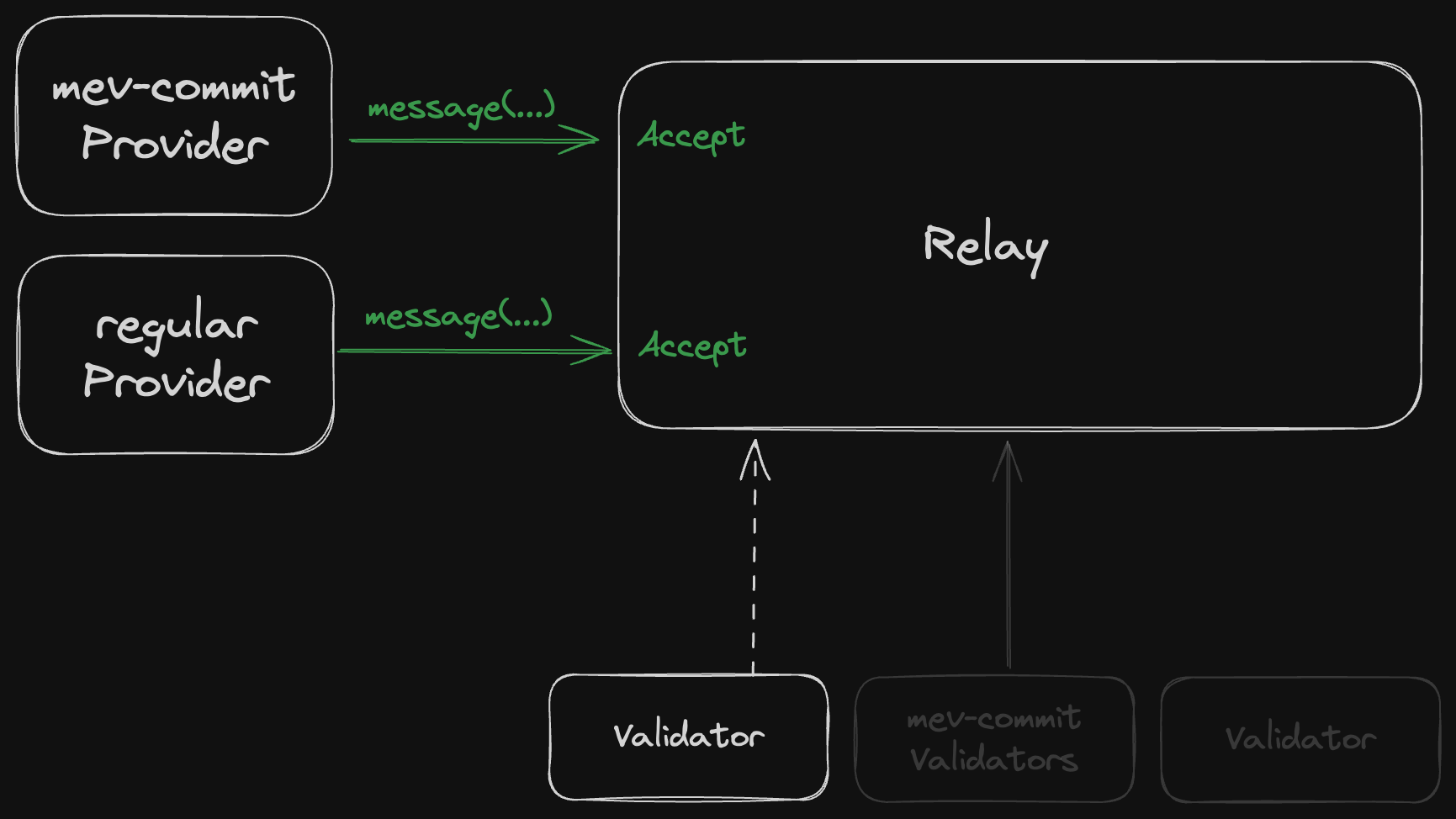 * If they have opted in, your relay only accepts blocks from mev-commit builders:
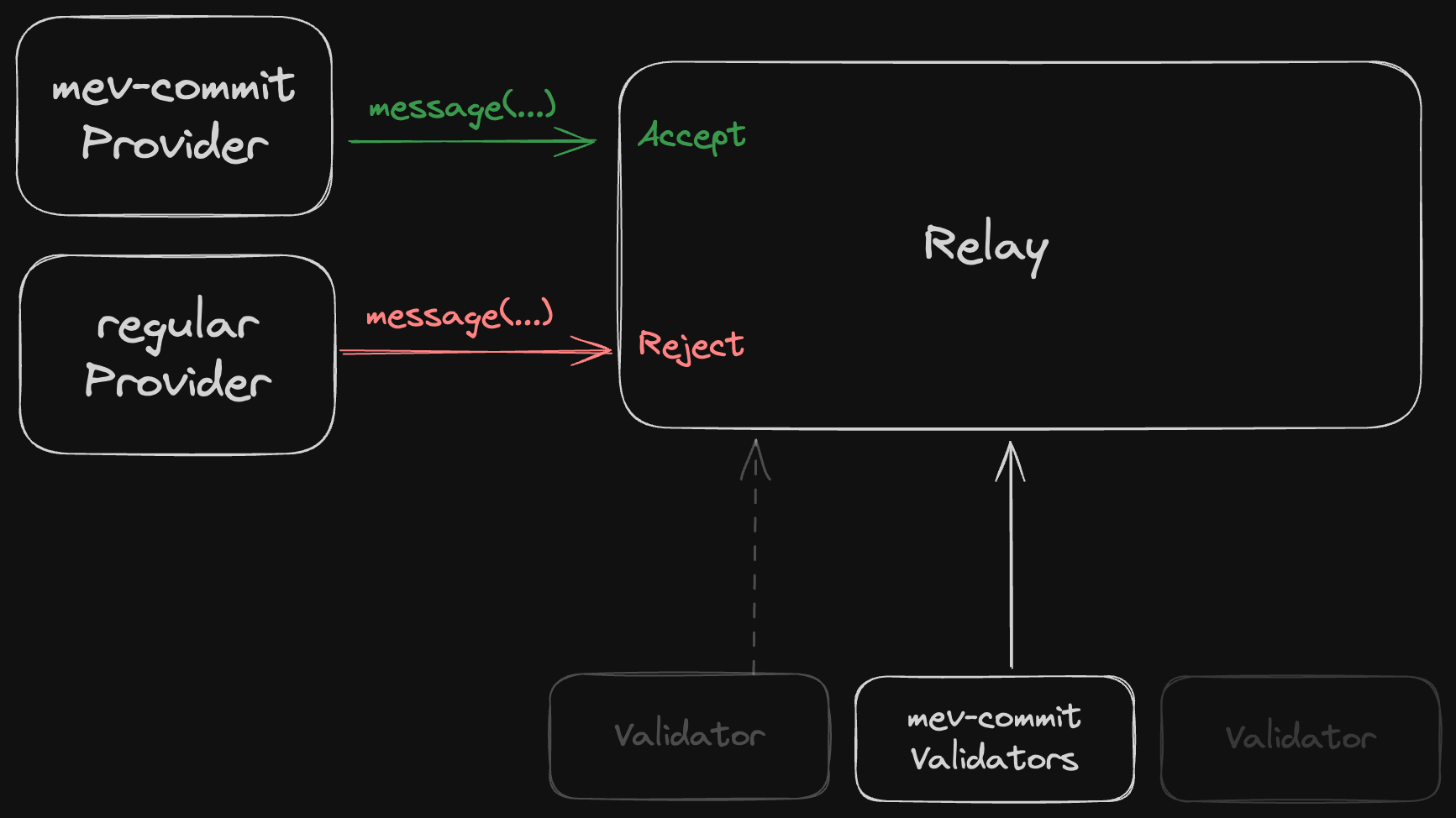 To implement this, your relay needs to track two things:
1. Provider Registry: Lists opted-in builders and their BLS keys
2. Validator Registry: Shows which validators have opted into mev-commit
## Quick Start
* Check out this [mev-commit relay integration](https://github.com/flashbots/mev-boost-relay/pull/657)
* Add required environment variables:
### Mainnet
{`
MEV_COMMIT_RPC=wss://chainrpc-wss.mev-commit.xyz
PROVIDER_REGISTRY_ADDR=${ProviderRegistryAddressMainnet1_0_0}
`.trim()}
### Testnet
{`
MEV_COMMIT_RPC=wss://chainrpc-wss.testnet.mev-commit.xyz
PROVIDER_REGISTRY_ADDR=${ProviderRegistryAddress_1_1_6}
`.trim()}
Test filtering behavior on Hoodi:
* Register a [test builder](/v1.1.0/get-started/quickstart)
* Submit [test bids](/bidders/best-practices#submit-bundles)
* Verify correct block filtering
1. Add your relay to our [supporting relays list](/v1.1.0/get-started/validators/validator-guide#supporting-relays)
2. Provide connection details for validators
3. Contact the Primev team to coordinate validator outreach
You have now successfully integrated your relay with mev-commit.
## Implementation Details
### What Contracts to Monitor
To track which validators have opted into mev-commit, you'll want to monitor the following contracts:
## Ethereum L1
| Network | Contract | Address |
| ----------- | ----------------------- | ---------------------------------- |
| **Mainnet** | Validator Opt In Router | {ValidatorOptInRouterProxyAddress} |
| **Hoodi** | Validator Opt In Router | {HoodiValidatorOptInRouterAddress} |
## mev-commit Chain
| Network | Contract | Address |
| ----------- | ----------------- | ------------------------------------- |
| **Mainnet** | Provider Registry | {ProviderRegistryAddressMainnet1_0_0} |
| **Testnet** | Provider Registry | {ProviderRegistryAddress_1_1_6} |
By monitoring these contracts, you can determine which validators and providers have opted into mev-commit and ensure compliance with the protocol.
### How to Query the Provider Registry
The mev-commit provider registry contract maintains the list of authorized providers such as block builders. You can query this contract to validate builder addresses.
**Contract Details:**
| Network | Address |
| ---------------------------- | ------------------------------------- |
| **mev-commit chain mainnet** | {ProviderRegistryAddressMainnet1_0_0} |
| **mev-commit chain testnet** | {ProviderRegistryAddress_1_1_6} |
You can retrieve all registered providers using the following script:
```javascript theme={null}
// Import the ethers library
const ethers = require("ethers");
// Define the provider using the RPC URL
const provider = new ethers.JsonRpcProvider("https://chainrpc.mev-commit.xyz/");
// Define the contract address and ABI
const providerRegistryAddress = "0xb772Add4718E5BD6Fe57Fb486A6f7f008E52167E";
const abi = [
"event ProviderRegistered(address indexed provider, uint256 stakedAmount)",
"function isProviderValid(address provider) public view",
"function getBLSKeys(address provider) external view returns (bytes[])"
];
// Create a new contract instance
const contract = new ethers.Contract(providerRegistryAddress, abi, provider);
// Function to retrieve BLS keys grouped by valid provider address
async function getRegisteredProviders() {
const filter = contract.filters.ProviderRegistered();
const events = await contract.queryFilter(filter);
let totalKeys = 0;
const providerMap = {};
for (const event of events) {
const providerAddress = event.args.provider;
try {
//This will fail if the provider isn't valid
await contract.isProviderValid(providerAddress);
const blsKeys = await contract.getBLSKeys(providerAddress);
// Convert each key to hex string for any future usage
providerMap[providerAddress] = blsKeys.map(key => ethers.hexlify(key));
totalKeys += blsKeys.length
} catch (error) {
// Skip invalid providers or failed fetches
}
}
console.log("Total registered keys: ", totalKeys);
return providerMap;
}
// Run and log providers with their BLS keys
getRegisteredProviders()
.then(providerMap => {
console.log("Valid providers and their BLS keys:");
for (const [address, blsKeys] of Object.entries(providerMap)) {
console.log(`\nProvider: ${address}`);
blsKeys.forEach((key, index) => {
console.log(` Key ${index + 1}: ${key}`);
});
}
})
.catch(error => {
console.error("Error fetching providers:", error);
});
```
The output will contain the number of all registered keys and a list of providers with their registered BLS public keys.
```bash theme={null}
Total registered keys: 23
Valid providers and their BLS keys:
Provider: 0x...
Key 1: 0x...
Provider: 0x...
Key 1: 0x...
Provider: 0x...
Key 1: 0x...
Key 2: 0x...
Key 3: 0x...
...
```
To implement this, your relay needs to track two things:
1. Provider Registry: Lists opted-in builders and their BLS keys
2. Validator Registry: Shows which validators have opted into mev-commit
## Quick Start
* Check out this [mev-commit relay integration](https://github.com/flashbots/mev-boost-relay/pull/657)
* Add required environment variables:
### Mainnet
{`
MEV_COMMIT_RPC=wss://chainrpc-wss.mev-commit.xyz
PROVIDER_REGISTRY_ADDR=${ProviderRegistryAddressMainnet1_0_0}
`.trim()}
### Testnet
{`
MEV_COMMIT_RPC=wss://chainrpc-wss.testnet.mev-commit.xyz
PROVIDER_REGISTRY_ADDR=${ProviderRegistryAddress_1_1_6}
`.trim()}
Test filtering behavior on Hoodi:
* Register a [test builder](/v1.1.0/get-started/quickstart)
* Submit [test bids](/bidders/best-practices#submit-bundles)
* Verify correct block filtering
1. Add your relay to our [supporting relays list](/v1.1.0/get-started/validators/validator-guide#supporting-relays)
2. Provide connection details for validators
3. Contact the Primev team to coordinate validator outreach
You have now successfully integrated your relay with mev-commit.
## Implementation Details
### What Contracts to Monitor
To track which validators have opted into mev-commit, you'll want to monitor the following contracts:
## Ethereum L1
| Network | Contract | Address |
| ----------- | ----------------------- | ---------------------------------- |
| **Mainnet** | Validator Opt In Router | {ValidatorOptInRouterProxyAddress} |
| **Hoodi** | Validator Opt In Router | {HoodiValidatorOptInRouterAddress} |
## mev-commit Chain
| Network | Contract | Address |
| ----------- | ----------------- | ------------------------------------- |
| **Mainnet** | Provider Registry | {ProviderRegistryAddressMainnet1_0_0} |
| **Testnet** | Provider Registry | {ProviderRegistryAddress_1_1_6} |
By monitoring these contracts, you can determine which validators and providers have opted into mev-commit and ensure compliance with the protocol.
### How to Query the Provider Registry
The mev-commit provider registry contract maintains the list of authorized providers such as block builders. You can query this contract to validate builder addresses.
**Contract Details:**
| Network | Address |
| ---------------------------- | ------------------------------------- |
| **mev-commit chain mainnet** | {ProviderRegistryAddressMainnet1_0_0} |
| **mev-commit chain testnet** | {ProviderRegistryAddress_1_1_6} |
You can retrieve all registered providers using the following script:
```javascript theme={null}
// Import the ethers library
const ethers = require("ethers");
// Define the provider using the RPC URL
const provider = new ethers.JsonRpcProvider("https://chainrpc.mev-commit.xyz/");
// Define the contract address and ABI
const providerRegistryAddress = "0xb772Add4718E5BD6Fe57Fb486A6f7f008E52167E";
const abi = [
"event ProviderRegistered(address indexed provider, uint256 stakedAmount)",
"function isProviderValid(address provider) public view",
"function getBLSKeys(address provider) external view returns (bytes[])"
];
// Create a new contract instance
const contract = new ethers.Contract(providerRegistryAddress, abi, provider);
// Function to retrieve BLS keys grouped by valid provider address
async function getRegisteredProviders() {
const filter = contract.filters.ProviderRegistered();
const events = await contract.queryFilter(filter);
let totalKeys = 0;
const providerMap = {};
for (const event of events) {
const providerAddress = event.args.provider;
try {
//This will fail if the provider isn't valid
await contract.isProviderValid(providerAddress);
const blsKeys = await contract.getBLSKeys(providerAddress);
// Convert each key to hex string for any future usage
providerMap[providerAddress] = blsKeys.map(key => ethers.hexlify(key));
totalKeys += blsKeys.length
} catch (error) {
// Skip invalid providers or failed fetches
}
}
console.log("Total registered keys: ", totalKeys);
return providerMap;
}
// Run and log providers with their BLS keys
getRegisteredProviders()
.then(providerMap => {
console.log("Valid providers and their BLS keys:");
for (const [address, blsKeys] of Object.entries(providerMap)) {
console.log(`\nProvider: ${address}`);
blsKeys.forEach((key, index) => {
console.log(` Key ${index + 1}: ${key}`);
});
}
})
.catch(error => {
console.error("Error fetching providers:", error);
});
```
The output will contain the number of all registered keys and a list of providers with their registered BLS public keys.
```bash theme={null}
Total registered keys: 23
Valid providers and their BLS keys:
Provider: 0x...
Key 1: 0x...
Provider: 0x...
Key 1: 0x...
Provider: 0x...
Key 1: 0x...
Key 2: 0x...
Key 3: 0x...
...
```